
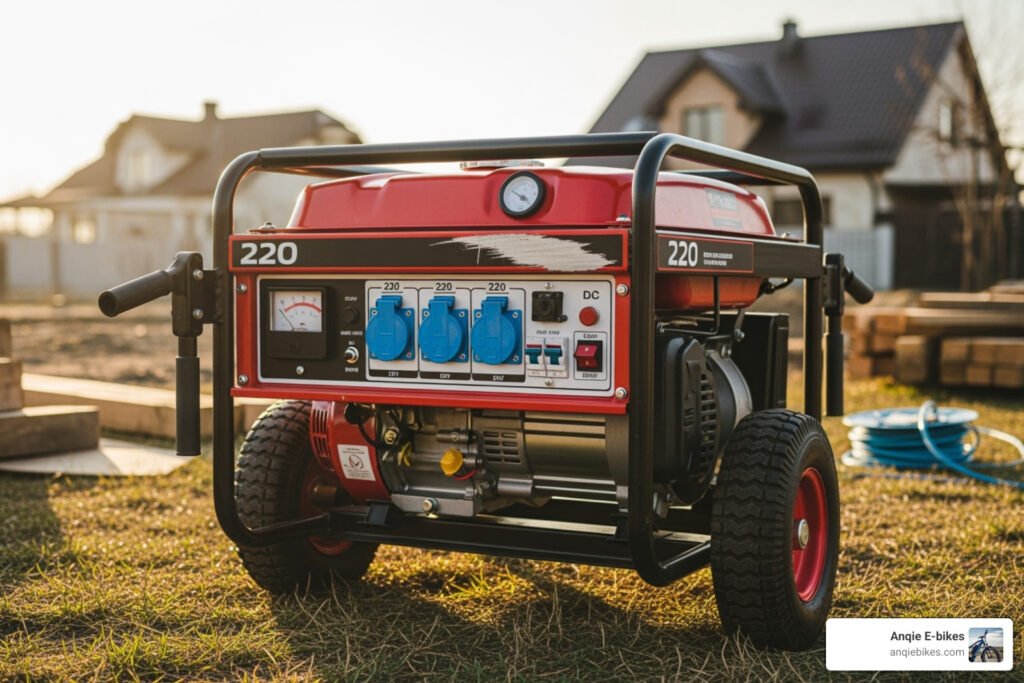
Why Understanding Generator 220 Volt Power Matters
A generator 220 volt provides higher-voltage power (220-240V) for heavy-duty appliances that standard 120V outlets can’t support. Here’s what you need to know:
Key Points About 220V Generators:
- Voltage Output: Delivers 220-240V power through specialized outlets (like L14-30R or 14-50R)
- Primary Uses: Powers well pumps, central air conditioning, electric dryers, welders, RV air conditioners, and large power tools
- Efficiency Advantage: Draws lower amperage than 120V for the same wattage, reducing strain on circuits
- Two Types: North American models (240V/60Hz) and International models (220V/50Hz) – they are not interchangeable
- Power Calculation: A 220V circuit drawing 10 amps delivers 2,200 watts of power
Whether for home backup, a job site, or off-grid living, understanding 220-volt power is crucial. The main challenge is choosing the right size. For example, a 220V well pump needing 3,000W continuous and a 5,000W startup surge requires at least an 8,750W generator. Experts recommend adding a 20% buffer, bringing you to a 10.5kW unit. Miscalculating can lead to overloading your generator or having insufficient power.
I’m mArk saToshi, and at Anqi E-Bikes, I’ve guided many customers through the complexities of power equipment. From understanding generator 220 volt specs to choosing backup power for RVs and off-grid use, my experience shows that the right generator is key to being prepared.
What Is a 220-Volt Generator and Why Do You Need One?
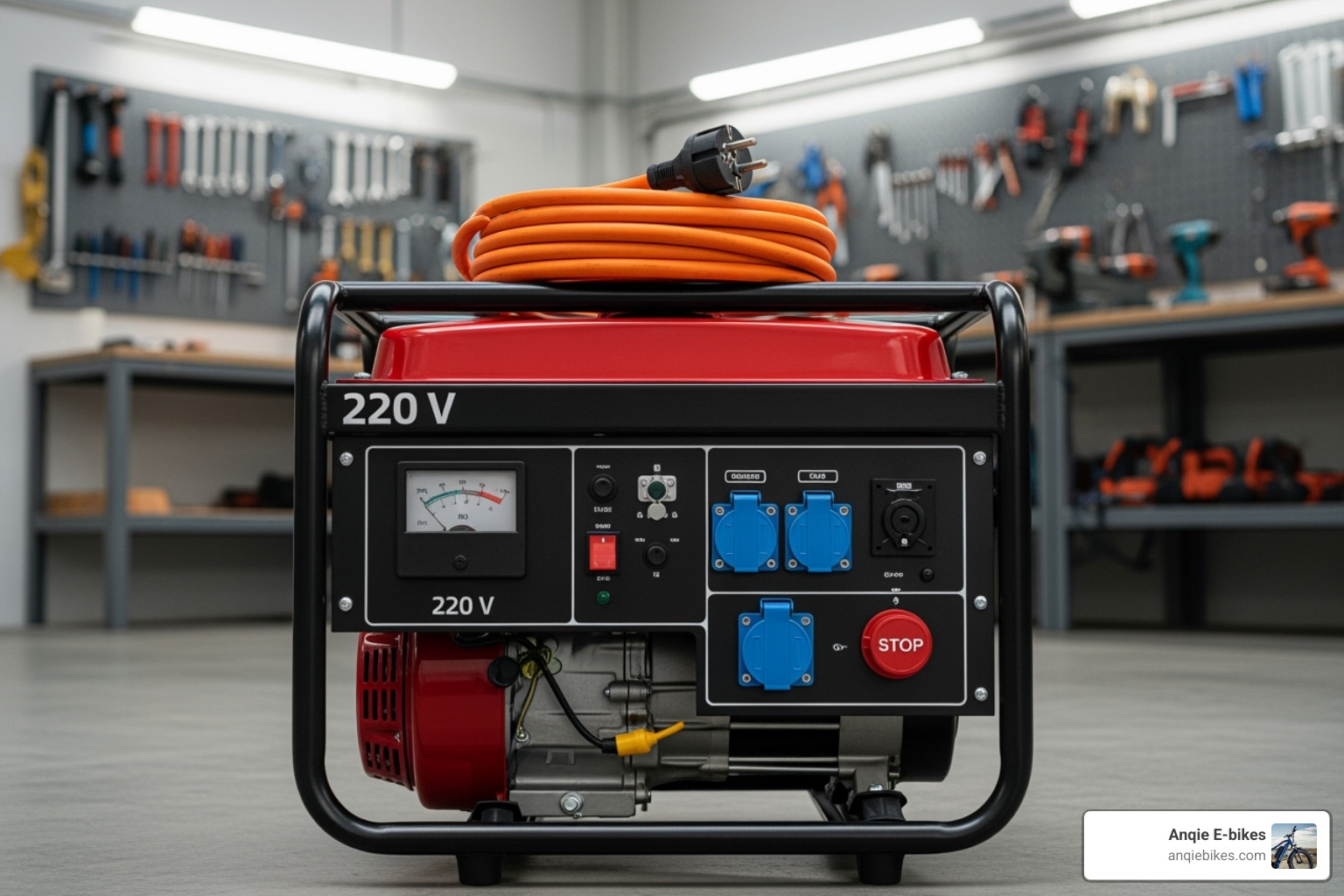
While standard 110-120V outlets power everyday items, some equipment needs more muscle. A generator 220 volt provides this high-voltage power. In North America, most generators use split-phase electricity, offering both 120V and 240V from one machine. You get standard 120V outlets plus special 240V outlets (like the L14-30R or 14-50R) for heavy-duty equipment.
International markets use a different 220V/50Hz standard, which is not interchangeable with North America’s 120/240V 60Hz system. You need a 220V generator for equipment that can’t run on standard household power, like a central air conditioner, electric dryer, well pump, or large construction tools.
Higher voltage offers an efficiency advantage: running equipment on 220-240V draws less amperage for the same work, reducing strain on circuits and improving performance. This is crucial for home backup systems, job sites, and running heavy machinery.
Key Differences: 110V/120V vs. 220V/240V Power
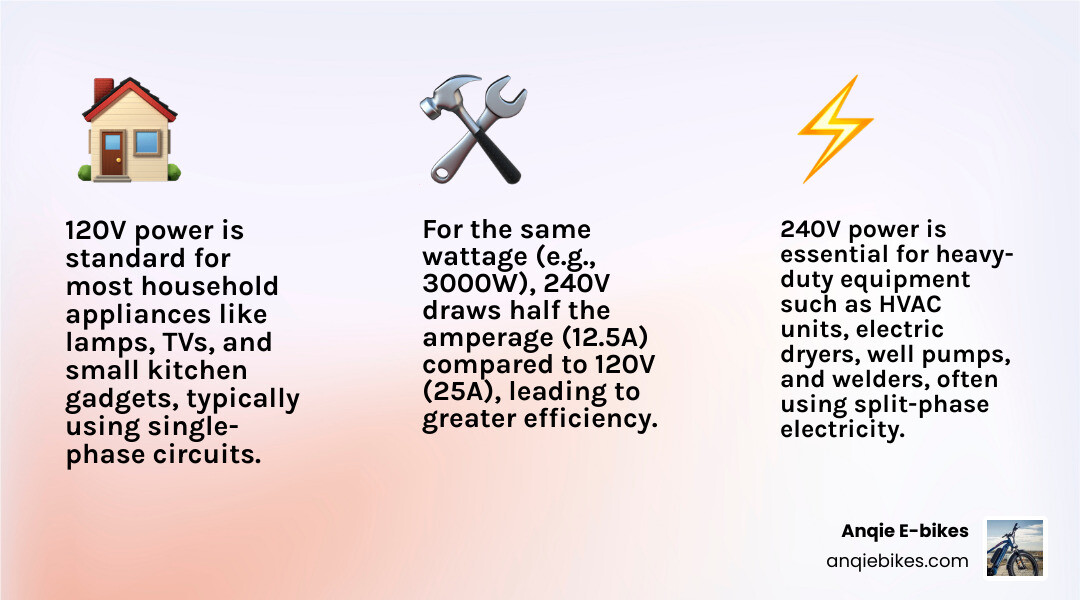
The formula Watts = Volts x Amps explains why 220-240V power is ideal for heavy equipment. For a 3000W appliance, a 120V circuit draws 25 amps (3000 / 120). On a 240V circuit, it only draws 12.5 amps (3000 / 240). Same power, half the current.
This lower amperage allows for thinner gauge wiring, which is cheaper and generates less heat. In North America, power enters the home at 240V and splits into two 120V lines. Regular appliances use one 120V line, while high-power appliances use both lines together for 240V.
Here’s how the numbers break down for that 3000W appliance:
| Feature | 120V Circuit (for 3000W) | 240V Circuit (for 3000W) |
|---|---|---|
| Voltage (V) | 120V | 240V |
| Amperage (A) | 25A | 12.5A |
| Wattage (W) | 3000W | 3000W |
| Wire Gauge Needed | Thicker | Thinner (for same wattage) |
| Typical Appliances | Lights, small electronics, kitchen appliances | Well pumps, electric dryers, central AC, welders |
The bottom line is that 240V circuits are more efficient for power-hungry equipment.
Common Applications for 220V Power
Many essential home appliances run on 220-240V. Your well pump is a prime example; without it, you have no water. Most deep well pumps require 240V. Your HVAC system, electric dryer, and water heater also need this higher voltage. A generator 220 volt keeps these critical systems running during an outage.
For a complete home backup solution, consider the Generac 7210 Guardian 24kW Standby Generator WiFi w/ 200 Amp Automatic Transfer Switch.
Construction sites rely on 240V for welders, large saws, and air compressors. RV enthusiasts need 240V for large roof-mounted air conditioners and running multiple appliances. Farm equipment, from irrigation pumps to grain elevators, also often requires 220V power.
How to Choose the Right Generator 220 Volt
Picking the right generator 220 volt is straightforward when you break it down. The key is to understand your power demands, analyze your use case (home backup, RV, job site), and assess your budget. Prices can range from around $500 for portable units to over $6,000 for heavy-duty models.
A homeowner’s needs differ from a contractor’s, and an RVer’s needs differ from a farmer’s. Let’s match your situation to the right generator.
Understanding Your Power Needs for a Generator 220 Volt
Correctly calculating your power needs is critical. You need to know two figures: Running watts (continuous power) and Starting watts (the initial surge for motor-driven equipment). A well pump might run on 1,200 watts but need 3,600 watts to start.
To calculate your needs, list all 220V appliances you’ll run simultaneously, noting their running and starting watts. This information is on the appliance nameplate or in a wattage reference chart.
Sum the running watts. Then, add the single highest starting wattage from your list. For safety, I recommend adding a 20-25% buffer to this total. This prevents overloading and extends your generator’s life.
For example: A 240V well pump (1,200W running, 3,600W starting) plus a window AC (1,000W running, 1,500W starting) and lights (300W). Total running watts: 2,500W. Highest surge: 3,600W. Total needed: 2,500W + 3,600W = 6,100W. With a 20% buffer, you’d need a generator of at least 7,320W. An 8,000W generator would be a safe choice.
Essential Features and Specifications
Once you know your wattage, consider these features:
- Wattage Output: The generator’s continuous running wattage must meet your calculated needs, and its peak wattage must handle the largest surge.
- Fuel Type: Gasoline is common but has a short shelf life. Propane burns cleaner and stores indefinitely. Diesel is fuel-efficient and durable for heavy use but costs more upfront.
- Dual-Fuel/Tri-Fuel: These generators offer flexibility by running on gasoline, propane, and/or natural gas, which is useful during extended outages.
- Engine Quality: Engines from established brands and those with lower RPMs (1,500 vs. 3,600) tend to be quieter and last longer.
- Noise Level (dBA): Inverter generators are quietest (48-60 dBA), like a normal conversation. Traditional models are louder (70-80+ dBA).
- Portability: Wheels and handles are essential for moving the generator, especially for job sites and RVs.
- Outlet Configuration: Ensure the generator has the 240V outlets you need, like the L14-30R (30-amp) or 14-50R (50-amp), plus standard 120V outlets.
- Inverter vs. Conventional: Conventional generators are fine for tools. Inverter generators produce “clean” power safe for sensitive electronics like laptops and are typically lighter and more fuel-efficient.
- Automatic CO Shutdown: This life-saving feature shuts the unit down if dangerous carbon monoxide levels are detected.
- Runtime: Indicates how long the generator runs on a full tank at a specific load (usually 50%). Longer runtimes mean less refueling.
Top Brands and Models
Brand reputation matters for reliability and service.
- Champion Power Equipment: Known for reliable portable generators with helpful customer resources.
- Honda Generators: Legendary for quiet, fuel-efficient inverter technology and backed by a strong 36-month warranty.
- Generac: A leader in home standby generators, like the Generac 7210 Guardian 24kW Standby Generator WiFi w/ 200 Amp Automatic Transfer Switch, and also offers great portables.
- DuroMax: Manufactures powerful generators, including popular tri-fuel options for maximum flexibility.
- Westinghouse: An established brand offering feature-packed portable generators at competitive prices.
- Yamaha: Produces quality, durable generators with dependable performance.
When choosing, check customer ratings, warranty terms, and the availability of parts and service. High satisfaction rates and strong warranties are good indicators of a quality product.
Operating Your 220V Generator Safely
Safety is non-negotiable when operating a generator 220 volt. These machines produce deadly, odorless carbon monoxide (CO) gas.
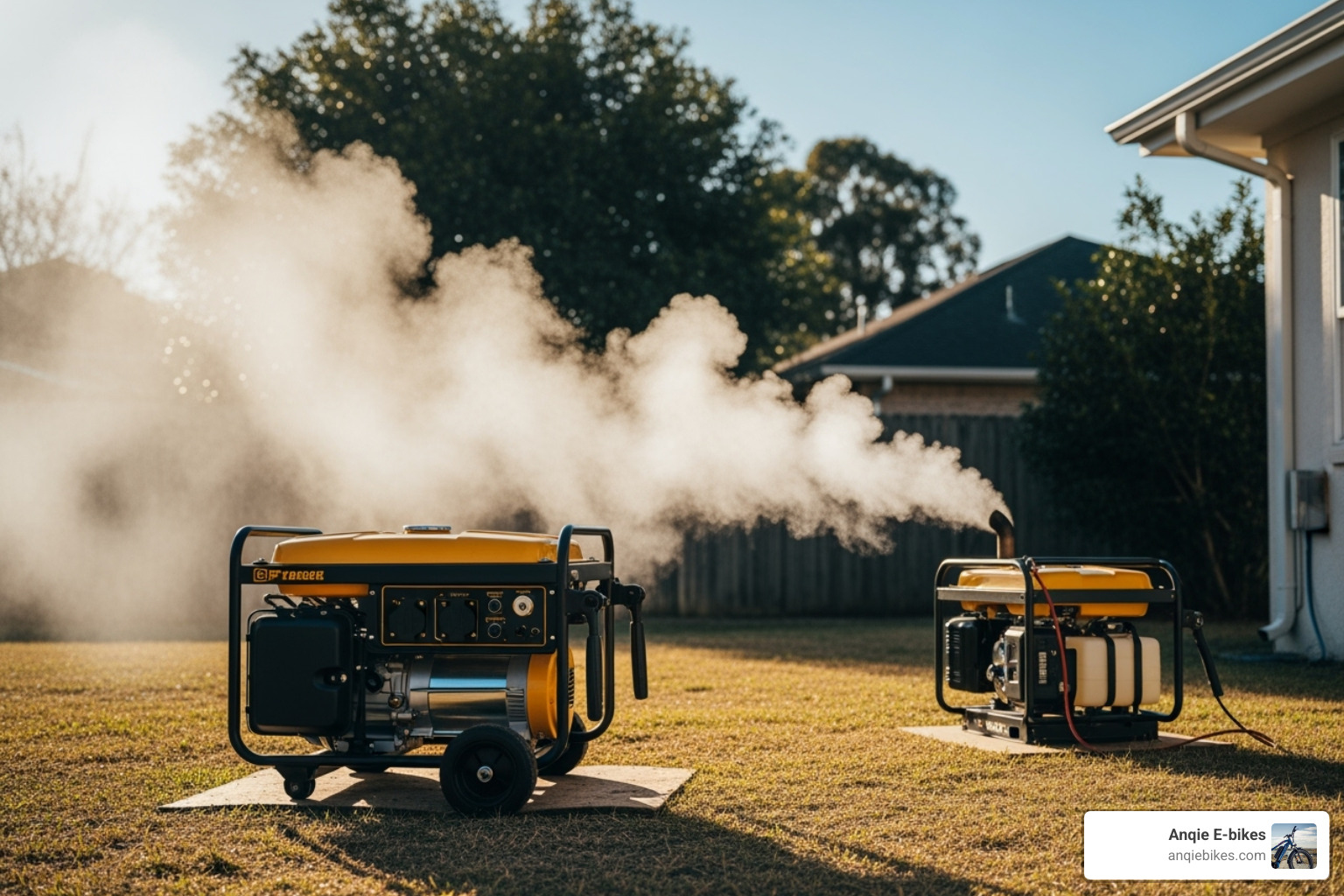
The most critical rule is to always operate your generator outdoors in a well-ventilated area, far from windows, doors, and vents. Never run a generator in a garage, even with the door open. Modern generators with automatic CO shutdown add a layer of protection, but they do not replace proper placement.
Also, consider these safety practices:
- Weather Protection: Use a generator cover or enclosure to protect the unit from rain and snow, ensuring it still has adequate airflow.
- Proper Grounding: Follow the manufacturer’s instructions for grounding to prevent electrical shock.
- Extension Cords: Use only heavy-duty, outdoor-rated cords of the correct gauge for your load. Never run cords under rugs.
- Transfer Switch: For home backup, a professionally installed manual or automatic transfer switch is the safest way to connect. It prevents dangerous back-feeding to utility lines.
- Refueling: Always turn off the generator and let it cool completely before adding fuel to prevent fires. Store fuel in approved containers away from heat sources.
A well-maintained generator is a safer generator.
International vs. North American Generator 220 Volt Models
The term “generator 220 volt” can be confusing because of a critical difference between North American and international models: frequency.
- North America: Operates at 60Hz, with power delivered at 120V and 240V (from a split-phase system).
- International (Europe, Asia, etc.): Operates at 50Hz, with voltage commonly at 220V, 230V, or 240V.
A 50Hz generator will not work correctly or safely with 60Hz North American appliances, and vice-versa. Running an appliance at the wrong frequency can cause it to overheat, run at the wrong speed, and fail. Plug types also differ. When buying, always confirm the generator’s frequency (Hz) and voltage match your location and appliances.
Maintenance Best Practices
Consistent care ensures your generator 220 volt will work when you need it. Follow the manufacturer’s schedule for these key tasks:
- Regular Oil Changes: Check oil before each use and change it per the manual (e.g., after the first 20-50 hours, then every 100-200 hours).
- Air Filter: Clean or replace the air filter regularly, especially in dusty conditions, to maintain performance.
- Spark Plug: Check the spark plug annually. Clean or replace it to ensure easy starting.
- Fuel System Care: Use a fuel stabilizer for gasoline to prevent it from going stale. For long-term storage, drain the fuel system or run the generator dry to prevent clogs.
- Battery: On electric start models, keep the battery charged and the terminals clean.
- Storage: Store the generator in a clean, dry place.
- General Inspection: Periodically check for loose parts, damaged cords, or leaks.
Following the owner’s manual is essential for reliability and warranty coverage.
Frequently Asked Questions about 220 Volt Generators
We get a lot of questions about 220-volt generators at Anqie E-bikes. Here are answers to the most common ones.
What size generator do I need to run a 220V appliance?
The size depends entirely on the appliance’s power needs. You must account for both running watts (continuous power) and starting watts (the initial surge for motors).
As detailed in the “Understanding Your Power Needs” section above, you need to calculate your total wattage requirement and add a 20-25% safety buffer. For example, a well pump that needs 3,000 running watts and 5,000 starting watts will require a generator rated for at least 10,500 watts to operate safely and reliably. Always do the math to avoid buying a generator that’s too small or unnecessarily large.
Can a 110V generator be converted to 220V?
The short answer is no. We strongly advise against attempting this. A generator’s internal wiring and alternator are specifically designed for its rated voltage. Modifying it is dangerous, risks fire and electrical shock, and will damage the generator and your appliances. It also voids the warranty.
While a step-up transformer is technically an option, it’s an inefficient, expensive, and unreliable solution. The safest and most practical choice is to purchase a generator 220 volt that is factory-built with dual-voltage capability, providing both 120V and 240V outlets.
What is the difference between 220V, 230V, and 240V?
These terms describe similar nominal voltage standards with slight regional variations. Most modern appliances are designed with enough tolerance to handle these small differences.
- 220V is a common standard in many parts of the world (at 50Hz).
- 230V is the harmonized standard for the European Union (at 50Hz).
- 240V is the high-voltage standard in North America’s split-phase system (at 60Hz).
The critical factor is not the minor voltage difference but the frequency (Hz). A 220V/50Hz generator from an international market will not work properly in North America, where the standard is 60Hz. Always match the frequency first.
Conclusion
Throughout this guide, we’ve explored why a generator 220 volt is vital for home backup, construction sites, and RVs. These generators deliver the high-voltage power that heavy-duty equipment demands, operating more efficiently by drawing lower amperage for the same wattage.
We’ve covered how to calculate your power needs, from running vs. starting watts to adding a crucial safety buffer. We’ve also highlighted essential features, from fuel types to automatic CO shutdown.
Success comes down to three things: proper sizing, choosing quality equipment, and uncompromising safety. A correctly chosen and responsibly used generator 220 volt is an investment in reliability and peace of mind.
At Anqie E-bikes, our reputation is built on guiding customers to the right solution, whether it’s an e-bike, an outboard motor, or power equipment. We bring that same commitment to expert guidance and exceptional service to every conversation about generators.
Don’t wait for a power outage or job site demand to catch you unprepared. A generator 220 volt is about maintaining your quality of life and keeping your work on track.
Ready to find the generator that fits your needs? We’ve got you covered. Explore powerful and reliable portable generators for all your needs, and let’s get you powered up for whatever comes next.